

Blog
Is Jump-Starting Hybrid Vehicles Prohibited?! Safety Tips You Must Know

Abstract:
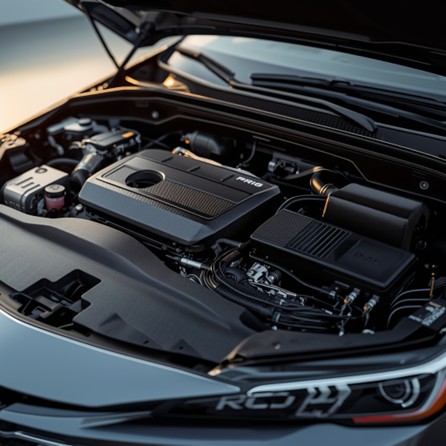
Hybrid vehicles, due to having two power sources (a gasoline engine and an electric motor), come with their own technical complexities. One common question about these vehicles concerns how to start them if the auxiliary (12-volt) battery becomes completely discharged. Is the traditional jump-start method safe for hybrid cars as well? In this article, we provide a comprehensive answer to this question and review critical safety precautions.
Introduction
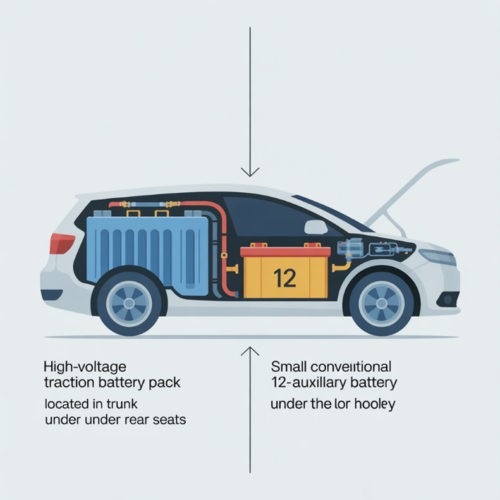
As you may know, hybrid vehicles are equipped with two types of batteries: a high-capacity, high-voltage traction battery that powers the vehicle in electric mode, and a 12-volt auxiliary battery—similar to those found in conventional vehicles—that operates the onboard computer systems, lights, and dashboard.
When the 12-volt battery runs out of charge, it is common—but potentially risky—to assume that the vehicle can simply be jump-started using cables and a gasoline-powered car.
1. Why Can Traditional Jump-Starting Be Dangerous?
Hybrid vehicles are equipped with highly sensitive DC-DC converters and advanced battery management systems. Supplying unstable or sudden current from a gasoline-powered vehicle can cause serious damage to these electronic circuits.
The main risks include:
Damage to the Battery Management System (BMS):
This system acts as the “brain” of the battery, and electrical fluctuations can disable or permanently damage it.
Short Circuit and Fire Hazard:
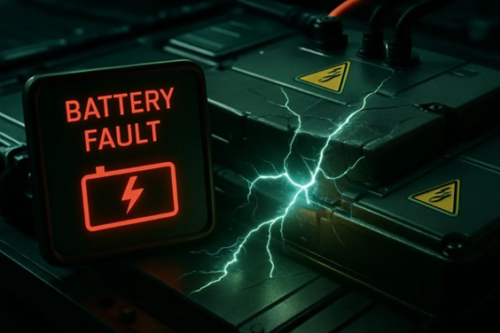
Incorrectly connecting the cables to the wrong terminals or creating a short circuit can be catastrophic and may even result in a fire.
Failure of the DC-DC Converter:
This component is responsible for converting the high voltage from the traction battery into 12 volts for auxiliary systems, and it is highly sensitive to voltage spikes.
Difficult Battery Access:
In some models, the 12-volt battery is located in the trunk or under the dashboard and is not easily accessible, which increases the risk of improper handling and potential damage.

2. The Correct Way to Start a Hybrid Vehicle
When starting a hybrid vehicle, you should never use the traditional jump-start method. The safest solutions include the following:
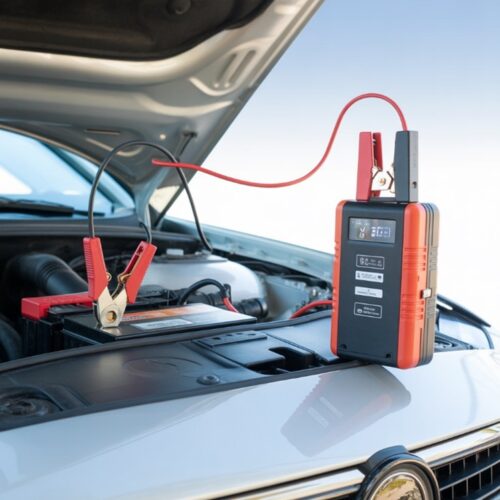
A) Using a Dedicated Jump Starter Device (Jump Box or Car Power Bank):
These devices provide stable and controlled current, ensuring greater safety. The procedure is as follows:
-
Consult your vehicle’s owner’s manual to locate the exact positive and negative terminals of the auxiliary battery (there may be designated jump-start terminals under the hood).
-
With the jump starter turned off, connect it to the battery (first attach the red positive cable, then the black negative cable).
-
Turn on the jump starter and attempt to start the vehicle.
-
Once the vehicle is on, disconnect the negative cable first, then the positive cable.
B) Using a Smart Battery Charger:
If you are not in a hurry, the best option is to disconnect the 12-volt battery and connect it to a smart charger designed for hybrid-compatible batteries.
C) Contacting Roadside Assistance or an Authorized Dealer:
If you are unsure about the process, the safest choice is to contact roadside assistance or an authorized dealership. Trained technicians are fully familiar with these systems and can handle the situation properly.
3. Types of Hybrid Batteries and Maintenance Tips
Understanding the different types of hybrid batteries helps ensure proper care and longer lifespan:
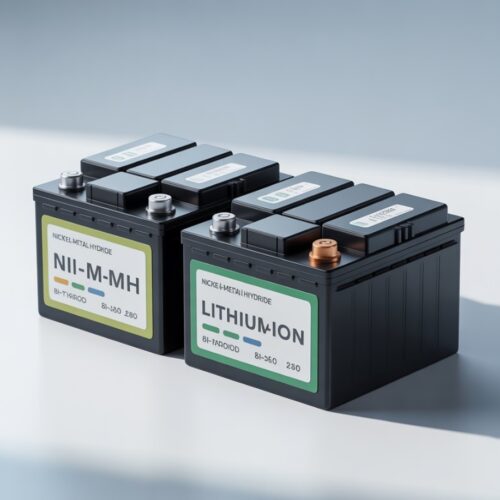
- Nickel–Metal Hydride (Ni-MH) Battery:
-
- Specifications: These batteries were commonly used in earlier hybrid models such as the first- and second-generation Toyota Prius. They are known for their durability and reliability, sometimes lasting up to 15 years. However, they are heavier and bulkier compared to newer battery technologies.
-
-
- Maintenance Tip: Ni-MH batteries can experience the “memory effect.” Occasional full discharge and recharge cycles may help recalibrate the system and maintain performance.
-
-
- Lithium-Ion (Li-ion) Battery:
-
-
- Specifications: This newer generation of batteries offers higher energy density and lighter weight. They are used in most modern hybrids and plug-in hybrids, including models such as the Hyundai Ioniq, Kia Niro, and later generations of the Toyota Prius. They are lighter, more compact, and more efficient.
-
-
-
- Maintenance Tip: Li-ion batteries are more sensitive to frequent fast charging. Avoid repeated rapid charging whenever possible, and try to keep the state of charge between 20% and 80% to help prolong battery life.
-
4. Key Tips for Extending the Life of a Hybrid Battery
Observing these simple tips can significantly increase the lifespan of your vehicle’s expensive battery:
-
Avoid frequent fast charging: Frequent fast charging, especially in lithium-ion batteries, generates excessive heat and puts stress on the cells. Use it only when necessary.
-
Be mindful of temperature: Extreme heat and extreme cold are both harmful to batteries. In summer, park the vehicle in the shade, and in winter, use a covered parking space if possible.
-
Long-term storage: If the vehicle will not be used for an extended period (more than one month), store it in an environment with moderate temperature (around 15 to 20 degrees Celsius). Keep the traction battery’s charge level between 40 and 60 percent. A fully charged or fully depleted battery is not suitable for long-term storage.
-
Take periodic maintenance seriously: During scheduled services, dealerships check the condition of the traction battery and its cooling system. These inspections can identify problems at early stages.
-
Regular driving: Hybrid batteries require regular use for optimal performance. If the vehicle is left unused for a long time, the battery may discharge and become damaged.
-
Pay attention to sounds and warnings: If you notice unusual noises from the battery area or warning lights appearing on the dashboard, visit the dealership immediately.
Conclusion
Jump-starting a hybrid vehicle using the traditional method can be highly risky and may cause serious damage to its sensitive electronic systems. The best approach is to carry a dedicated jump starter device (car power bank) and carefully read the vehicle’s owner’s manual. By following the maintenance tips mentioned above, you can maximize the lifespan of your hybrid vehicle’s expensive battery and enjoy driving this advanced technology. In case of any issue or uncertainty, the safest solution is to contact roadside assistance or an authorized dealership.

